Healthy Gut Journal
Healthy Gut Journal
- Home > Health > Digestive Health
Gastroenterology Nurse: “This Is The Fastest Way To End Constipation For Good”
- Mon. Sep. 7th, 2026 | 9:15 am EST - 251.328 👁
Written by Linda R., RN, Retired Gastroenterology Nurse |

I spent 34 years helping women with bowel problems.
Then, at 63 years old, I found myself lying on an emergency room table while a young doctor removed a mass of hardened stool from my body by hand.
I stared at the ceiling and cried without making a sound.
I could hear my husband, Gary, waiting outside.
All I could think was:
How did I let it get this bad?
I had not had a bowel movement in eleven days.
By then, I could barely eat. My stomach was swollen and hard. Waves of pain kept folding me over, yet no matter how hard my colon cramped, the blockage would not move.
The stool had become too dry.
It was stuck inside me like concrete.
I wish I could say this happened because I ignored the warning signs.
It did not.
I ate fiber. I drank water. I walked after meals. I tried stool softeners, powders, magnesium, Miralax, senna, and prescription medication.
I did everything women with constipation are told to do.
Yet my bowel movements became smaller, harder, and less frequent every year after menopause.
If you are over 50 and passing dry pellets every few days, straining until your face burns, or standing up from the toilet knowing you are still full, please keep reading.
Especially if you keep telling yourself it is not bad enough yet.
That is what I told myself right up until Gary found me shaking on the bathroom floor.
What happened next led me to a strange detail on my colonoscopy screen that finally explained:
Why my body stopped going after 50, and why it had nothing to do with fiber, water, or willpower.
Why the laxatives I'd been taking for years were the reason it kept getting worse.
And the simple fix that ended seven years of constipation in under five weeks.
At 56, Constipation Started Controlling My Life

Before menopause, I never thought about bowel movements.
I woke up, made coffee, went to the bathroom, and got on with my day.
Then I turned 56.
At first, I simply skipped a morning.
Soon I was going every third day.
Then every fourth.
When something finally came out, it was usually a handful of hard pellets.
I would sit there for thirty or forty minutes, leaning forward, holding my breath, and straining until my face felt hot.
Sometimes I would brace my feet against the floor and push so hard that I became dizzy.
Then I would look into the toilet and think:
That cannot be all of it.
The worst part was standing up and still feeling the same heavy pressure inside me.
By lunchtime, my stomach would be swollen beneath my clothes. I stopped wearing fitted pants because the waistband cut into my belly.
I began eating smaller meals because adding more food to a body that already felt full made me anxious.
Constipation started making decisions for me.
I avoided long drives. I checked bathrooms everywhere we went. I canceled Sunday lunch with our daughter twice because I had not gone in nearly a week and could not bear sitting at the table pretending I felt fine.
Gary knew why I was staying home, but neither of us talked about it.
I was embarrassed.
That sounds ridiculous because I had spent my career telling women there was nothing embarrassing about constipation.
But it felt different when it was my body.
So I kept trying to fix it myself.
More fiber made the pressure worse.
Miralax helped briefly, then stopped being reliable.
Linzess either did nothing or kept me cramping near the bathroom.
Eventually, I started taking senna.
At first, one dose worked.
Then I needed it more often.
Soon, even when it worked, I would spend the night cramping, rush to the bathroom, pass something loose, and still feel as though a larger mass remained behind.
I was not becoming regular.
I was forcing occasional evacuations while the real problem continued underneath.
Then I went eleven days without going.
On The Eleventh Night, My Body Finally Gave Up

The first four days did not scare me.
I had gone that long before and something always happened eventually.
By day six, I could no longer button my jeans.
By day eight, I had almost stopped eating.
By day ten, the pressure inside me felt like a bowling ball pressing against my pelvis.
I knew what was happening.
It was an impaction.
Stool had remained inside my colon so long that the moisture had been pulled out of it. What remained had hardened into a dense mass that my body could not move.
I had seen it happen to patients.
I still could not make myself go to the hospital.
I tried an enema. Nothing moved.
I took Dulcolax. My colon squeezed harder, but the blockage stayed exactly where it was.
That was the most frightening part.
I could feel my body pushing with everything it had, yet the stool would not slide forward.
Shortly after midnight, the pain became sharp enough to make me vomit.
Gary found me on the bathroom floor at two in the morning. My nightgown was soaked with sweat and my hands were shaking.
At the hospital, they gave me fluids and something for the pain.
Then a resident who looked younger than our daughter explained that the stool was too hard to pass and would need to be removed manually.
There was no dignity left.
Only relief that the pain might finally stop.
Gary drove me home before sunrise.
Neither of us said much.
Two weeks later, I went in for a colonoscopy.
That was when I saw the clue that changed everything.
My Colonoscopy Looked Wrong

I had assisted with hundreds of colonoscopies during my nursing career.
A healthy colon usually looks pink, smooth, and moist.
Mine looked pale and dull.
It reminded me of the inside of a dry paper bag.
I asked my gastroenterologist why the lining looked so dry.
He glanced at the screen and told me I was probably dehydrated.
“Drink more water.”
Then he moved on.
I had drunk more water.
I had carried bottles everywhere for years.
Yet the stool inside me still dried into rocks.
That was the question I could not let go:
If I was drinking so much water, why was none of it keeping my stool soft?
I went home and began reading.
What I discovered made seven years of failed solutions suddenly make sense.
My Colon Was Dry
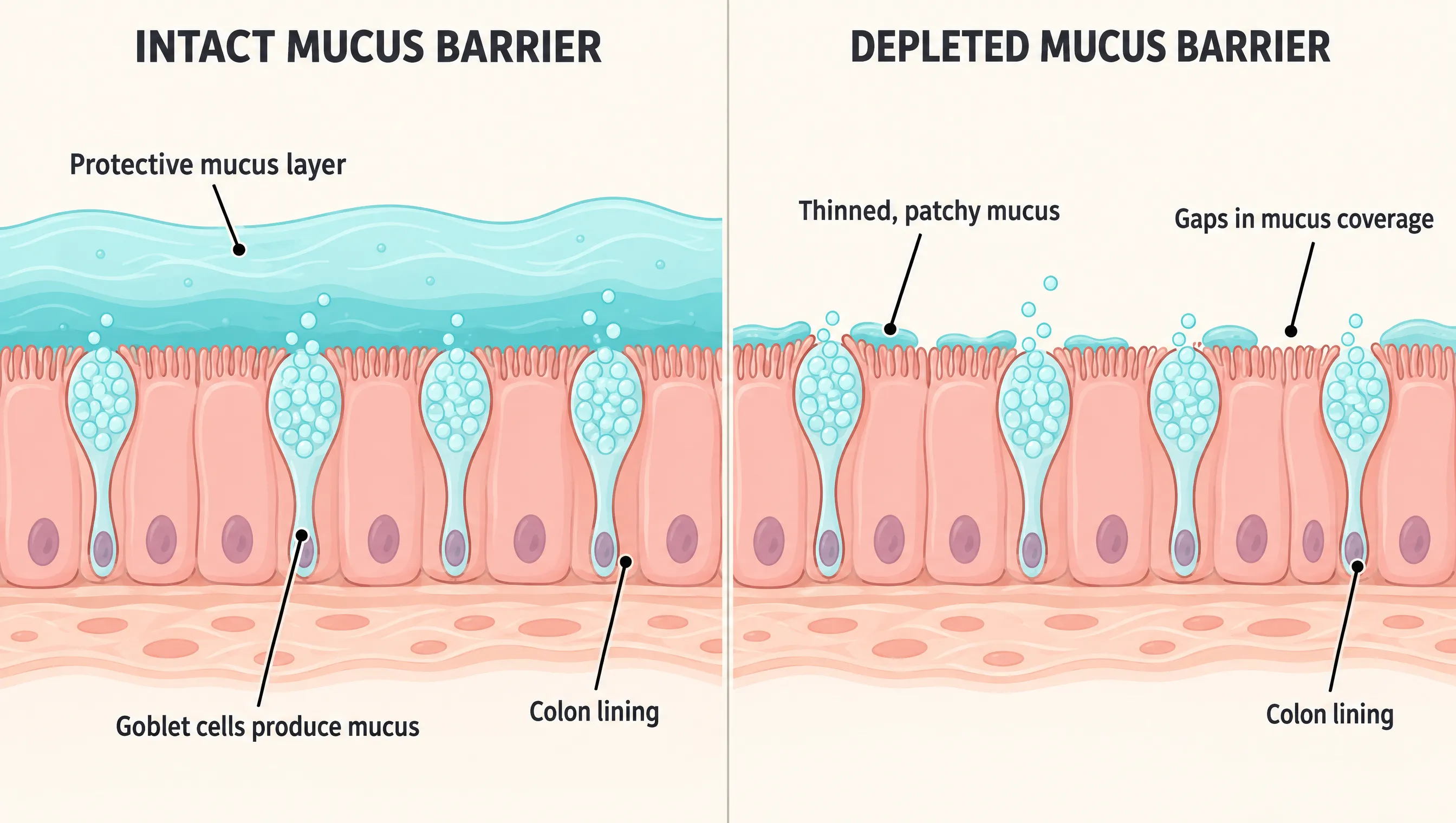
Your colon is not supposed to be a dry tube.
Its wall is covered by a thin layer of mucus produced by tiny goblet cells.
That mucus keeps the colon slippery. It coats the stool, helps it hold moisture, and allows it to glide forward without sticking to the wall.
At the same time, your colon is constantly pulling water out of waste.
When the mucus lining is healthy, there is a balance. The colon removes enough water to form the stool while the mucus helps keep it soft, coated, and moving.
But menopause can disturb that balance.
Estrogen helps regulate mucus-producing tissue throughout a woman’s body.
When estrogen falls, women often notice dryness in their skin, eyes, and mouth.
But dryness can also affect tissues they cannot see.
As the mucus lining inside the colon becomes thinner, the stool loses part of the slippery, moisture-holding barrier that once protected it.
The colon keeps pulling out water.
The stool becomes dry.
Dry stool moves more slowly.
And because it moves more slowly, the colon has even more time to pull out more water.
That creates a vicious cycle:
Less mucus. Drier stool. Slower movement. Even more water removed.
The longer the stool sits, the harder it becomes.
That is how a normal bowel movement turns into pebbles, then days of pressure, and eventually a mass that feels cemented inside you.
It explained why I could strain for forty minutes, pass three pellets, and still feel full.
I was not emptying.
I was breaking small pieces from a larger dry stool that could not slide forward.
It also explained why my old solutions kept failing.
Water alone was not enough because my stool could not hold onto it.
Fiber added more bulk to a colon that was already dry and packed.
Stimulant laxatives squeezed the colon harder, but they did not restore the slippery lining or stop the stool from drying again.
It was like pushing harder down a waterslide after somebody turned off the water.
The problem was not a lack of force.
The problem was that the slipperiness was gone.
For the first time in seven years, I knew what a real solution needed to do.
I Needed To Rebuild The Lining, Bring In Water, And Keep It There
I stopped looking for another product that simply forced a bowel movement.
Instead, I searched for three things:
Something to restore the slippery mucus lining.
Something to bring water directly into the colon.
And something to help the stool hold that water until it left my body.
That search led me to three ingredients.
1. Triphala To Restore The Slippery Lining
The first was an Asian fruit blend called Triphala.
This was the ingredient that went after the root of the dry-colon problem.
Triphala helps wake up the goblet cells responsible for producing mucus, even without the estrogen signal they once depended on.
In studies, it increased colon mucus production by more than 300% and restored goblet-cell output to healthy, pre-menopausal levels.
A 2018 study in the PubMed Central database found that Triphala helped restore the lining of the digestive tract.
Research from the University of Liege also found that it fed bacteria connected to healthy mucus production.
It did not simply force waste through a damaged, dry colon.
It helped rebuild the slippery surface normal movement depends on.
It also supported the colon’s natural nerve pathways, helping the bowel contract normally instead of irritating the wall and forcing another emergency evacuation.
This was the piece every laxative had missed.
2. Magnesium Oxide To Bring The Water Back
Normal stool is roughly 75% water.
That moisture is what allows it to move.
But when stool sits inside a dry colon, the wall keeps pulling water away until what remains becomes hard and packed.
Magnesium can help bring water into the bowel, but the form matters.
Many types of magnesium absorb into the bloodstream before reaching the colon.
Magnesium oxide absorbs poorly.
For regularity, that is the advantage.
More of it remains inside the digestive tract, where it can gently draw water toward the dry stool that needs it.
Instead of squeezing harder, it helps soften what is stuck.
3. Kiwifruit Extract To Keep The Stool Soft
Bringing water in was only half the answer.
I also needed to stop that moisture from being pulled straight back out.
Kiwifruit contains natural water-holding compounds that help bind moisture inside the stool.
That allows the stool to remain softer as it moves through the colon instead of drying back into pellets.
A trial published in the American Journal of Gastroenterology followed 184 people and found that kiwifruit produced at least 1.5 additional complete bowel movements per week.
It even outperformed psyllium.
Now I had the complete answer:
Triphala rebuilds the lining.
Magnesium oxide brings in the water.
Kiwifruit helps keep it there.
Restore. Rehydrate. Retain.
For the first time, I was addressing the entire dry-colon cycle instead of forcing one desperate bowel movement.
There was only one problem.
I could not find all three ingredients together in the forms and amounts I wanted.
I Couldn’t Find It Anywhere
Finding Triphala online was easy.
Finding an extract I trusted was not.
I ordered samples from six suppliers.
Some were weak. Some used the wrong extraction method. One arrived in an unmarked plastic bag and went directly into the trash.
Eventually, I found a verified supplier and paid for independent testing.
Then I sourced the magnesium oxide and kiwifruit extract.
After weeks of testing and measuring, I finally had all three ingredients on my kitchen counter.
I filled the first capsules by hand and began taking them every night.
Four mornings later, something happened that I had almost forgotten was possible.
On Day Four, My Body Gave Me A Natural Urge

It was not a cramp.
It was not the sudden panic that came after taking a laxative.
It was a quiet, natural urge.
I sat down and went without sweating, straining, or bracing my feet against the floor.
When I stood up, I felt empty.
Not partially relieved.
Empty.
During the first week, I went three times.
By the second week, I was going every other day and the hard pellets were disappearing.
By the fourth week, I was going almost every morning.
The pressure beneath my ribs faded. My stomach stopped swelling by lunchtime. I buttoned pants I had not worn in months.
Then our daughter invited us to Sunday lunch.
Normally, I would have counted how many days it had been and worried about eating away from home.
This time, I simply went.
I ate a full meal, laughed with my family, and spent the entire afternoon without thinking about my stomach.
On the drive home, I realized I had not thought about my colon once.
That was when I understood what I had really gotten back.
It was not just bowel movements.
It was freedom.
Then Other Women Started Asking Me For The Capsules
I shared the combination with four women close to me.
Carol, my 67-year-old neighbor, had used Miralax every day for three years and still went only twice a week.
Six days after starting, she texted me:
“Linda, I went this morning without even trying.”
Barb was another retired nurse whose constipation had worsened after her hysterectomy.
She called me on day eleven and said:
“I forgot what going normally felt like.”
My sister Diane had depended on laxatives every night for five years.
Within three weeks, she had stopped reaching for it.
Each woman asked the same question:
Why had nobody explained this to us before?
I could not stop thinking about that.
I Couldn’t Keep This To Myself

I knew there were millions of women struggling exactly as I had, wondering why their bodies had stopped working and blaming themselves when nothing helped.
I had to find a way to get this into their hands. But mixing capsules in my kitchen was not a solution.
So I began contacting supplement manufacturers.
The first could not source the Triphala I trusted.
The second sent a sample that tested far below the potency promised.
Then two manufacturers suggested adding senna so women would “feel it working” immediately.
I refused.
I had not spent seven years escaping stimulant laxatives just to hide one inside another product.
Eventually, I found Lanural and a manufacturer in Texas that understood exactly what I wanted.
A stimulant-free nightly formula built around all three parts of the dry-colon cycle.
It took four formulations and one rejected batch.
Then we finally got it right.
Introducing Regularity Reset

Regularity Reset is a three-part nightly formula designed to restore the slippery lining, bring water into the bowel, and help stool hold that moisture long enough to pass comfortably.
Every serving contains:
Triphala Extract, 300 mg to support the intestinal lining, mucus production, and natural bowel movement.
Magnesium Oxide, 500 mg to help draw water toward dry stool.
Kiwifruit Extract, 500 mg to help the stool retain moisture and remain soft.
Simply take three capsules at night before bed.
There is no fiber drink to choke down and no stimulant designed to create sudden urgency.
The formula works overnight, when your body is already preparing for the following morning.
So instead of waking up and forcing yourself to sit on the toilet without an urge, your body can begin giving you that natural signal again.
These women were not asking for a miracle.
They just wanted to feel a natural urge.
They wanted something soft to pass without tearing, sweating, or straining.
They wanted to stand up and feel finished.
They wanted a normal morning.

Deborah M. — Tampa, Florida
"
Six days in, I went normally for the first time in probably four years. I called my daughter crying because I had accepted this was simply how the rest of my life would be."
Check Availability Now
Patricia L. — Columbus, Ohio
"
I was taking Dulcolax three nights a week. I have now gone nine weeks without reaching for it, and most mornings my body goes on its own."
Check Availability Now
Marilyn K. — Scottsdale, Arizona
"
I am 74 and have struggled since my hysterectomy. This was the first thing that made my bowel movements feel normal again."
Check Availability NowThey Told Us To Charge $99. I Said Women Had Already Paid Enough.

The ingredients inside Regularity Reset are genuinely difficult to source, and every batch has to pass third-party testing before we'll put it into production.
Based on what goes into this formula, what it costs to source and test, and the results women are getting, we were told to sell it at $99 a bottle.
And honestly, for something that treats the root cause of constipation and actually fixes it, that would be fair.
Some women have told us their constipation never came back after finishing their supply.
There is nothing else on the market that can say that.
But I refused to keep it there.
Women like us have already spent enough money on powders, pills, prescriptions, and products that never fixed a thing.
I wasn't going to make this another one of those.
So while the current supply lasts, we've put Regularity Reset at just $59 a bottle. That's 40% off.
And because you save on shipping when bottles go out together, we're passing that savings on:
3 bottles for $49 per bottle. That's over 50% off.
6 bottles for $39 per bottle. That's over 60% off.
The six-bottle option is the best value we've ever offered, and the one most women go with because the lining rebuilds best when you give it a few months.
This discount won't last. It can't.
The moment this batch sells through, the price goes back up, and I can't promise when the next one will be ready.
See today's pricing below while it's still available.
I Have To Be Honest About Availability
Lanural is a small company, and this is not a product they can make more of on demand.
We've sold out three times since launch.
The longest stockout lasted just under seven weeks, and I spent those seven weeks reading emails from women asking when it was coming back. Some had been waiting since before the shortage started.
If the button above is working, there's stock right now. That may not be true next week.
And please understand what waiting actually costs you.
This condition does not hold still. Every day you stay constipated, more goblet cells die off and more of your lining disappears.
Every laxative you take damages more of the cells you need to rebuild.
Your goblet cells can regenerate. They want to. But the longer you wait, the more of them you lose and the longer the rebuild takes.
I waited seven years and it cost me a hospital bed at 2 AM.
Try It For 60 Days And Let Your Own Body Answer

Every order is protected by our full 60-day money-back guarantee.
Take Regularity Reset consistently.
Notice whether your natural urge begins returning.
Notice whether your stool becomes softer and easier to pass.
Notice whether you begin standing up feeling lighter, flatter, and more complete.
If you do not feel a meaningful difference within 60 days, contact us for a refund according to the guarantee terms.
You do not have to take my word for it.
You can let your own body decide.
This Is What’s Waiting For You

If you close this page, tomorrow morning will probably begin like so many mornings before it.
You will press your hand against your stomach and count how many days it has been.
You will sit on the toilet even though there is no urge because you are afraid to let another day pass.
Maybe a few hard pellets will come out.
Maybe nothing will happen.
Then you will face the same choices again.
More fiber, even though it makes you feel more packed?
Another laxative, even though you know it may keep you trapped near the bathroom?
Another small meal because you are scared to add food to a body that already feels full?
The next eleven-day nightmare will not announce itself as an emergency.
It will begin exactly like the last bad stretch did.
With one more morning of telling yourself it is not serious enough yet.
Now picture a different morning a few weeks from today.
You wake up without immediately pressing on your stomach.
You make coffee.
Before you finish the cup, your body gives you a quiet, natural urge.
You sit down without bracing for another battle.
The stool is soft.
It moves without scraping.
You do not strain until your face burns or sit there for forty minutes hoping something else will come.
Your body empties.
You stand up feeling finished.
Three minutes later, you are getting dressed.
You eat breakfast without wondering if you are making tomorrow worse.
You leave the house without checking every bathroom along the way.
You meet your daughter for lunch and order what you want instead of choosing whatever you think will cause the least pressure.
Then, while getting ready for bed, something hits you.
You did not think about your colon once all afternoon.
That is what constipation took from me.
Not just the ability to go.
The ability to eat, travel, wear what I wanted, make plans, and be present with the people I loved without constantly calculating what was happening inside my stomach.
You have already spent enough mornings straining.
You have already hidden your stomach beneath loose clothes.
You have already canceled enough plans, swallowed enough powders, and blamed yourself for a body that changed without anyone explaining why.
You were never the problem.
You were trying to force dry stool through a colon that had lost the slippery protection it once depended on.
Regularity Reset was created to support what went missing.
Restore the lining.
Bring back the water.
Keep the stool soft.
If the order button is still active, you can still try Regularity Reset for over 60% off, protected by the full 60-day guarantee.
Do not wait for another painful week to decide you have had enough.
You have already lost enough mornings to constipation.
Let tomorrow be the beginning of getting them back.
INTERNET ONLY OFFER!

LIMITED TIME READER-ONLY SPECIAL:
Over 60% off while the current supply lasts.